
Can I Pay Off a $380K Mortgage Before Retiring at 62? The Real Numbers

Updated: Jul 14

It's the most common question in my work, just dressed-up differently. Sometimes it's $420K and 60. Sometimes it's $550K and 65. The shape is always the same: a loan term that runs well past a retirement date, and no tested plan to close the gap.
Here's how I worked through it. The details below are generalised so nobody is identifiable. The maths is real. The names aren't.
The situation
Craig is 54, Sandra is 52. Combined income around $195,000. They owe $380,000 on their Brisbane home with 21 years left on the term. Same bank for 12 years. Never asked for a reprice. Minimum repayment: $2,770 a month, which they meet comfortably.
Craig wants to stop full-time work at 62. That gives them 8 years.
The loan gives them 21.
That 13-year gap is the whole problem. Not the rate. Not the repayment. The gap.
The wrong question
Most people at this point ask: "Can we afford the loan?" They can. That's exactly why nothing changes. The repayment is comfortable, the bank is happy, and the loan quietly runs to age 75.
At 54, the question is not just "can I afford the loan today?" It’s "will this loan still be here when my income changes?"
What happens if they change nothing
At $2,770 a month, Craig turns 62 still owing about $290,000.
That debt doesn't retire when he wants to. It gets serviced from super drawdowns, part-time work, or a forced sale to downsize. Their combined super is around $460,000 and still growing. A $290K mortgage hanging over that balance changes what retirement actually looks like, at exactly the moment the money is supposed to fund living rather than the bank.
The mortgage clock and the retirement clock are not moving at the same speed.
The raw target
Clearing $380,000 over 8 years at their current 6.50% rate needs about $5,090 a month. Nearly double their current repayment. If I'd stopped there, the honest answer would have been "probably not".
But that number assumes their current structure. And their current structure was working against them.
The assumptions, on the table
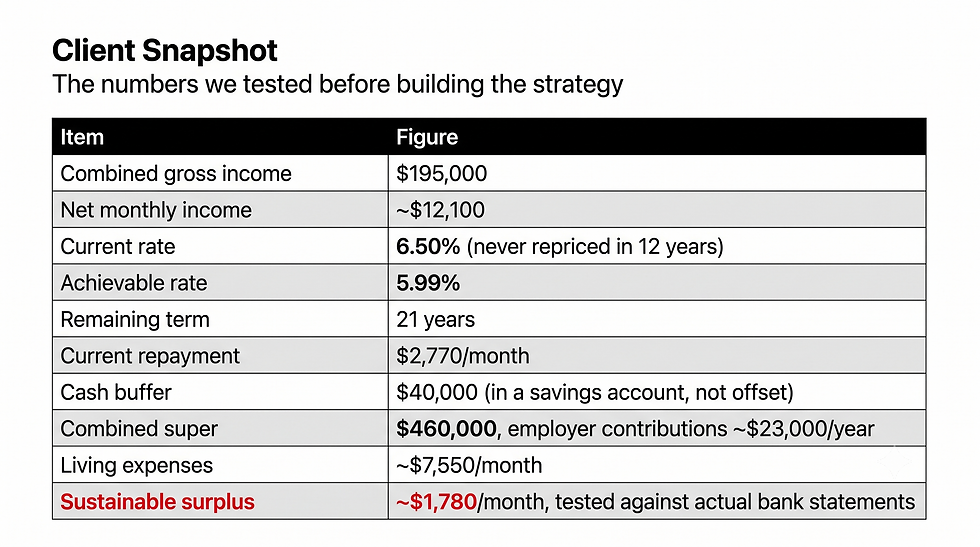
Every figure is rounded. Precision to the dollar over 8 years is fiction, and I'd rather show you honest rounding than confident nonsense.
Three structural changes
One. Fix the rate, without resetting the term.
Twelve years of loyalty had them at 6.50% while the sharpest variable rate I could find for their situation was just under 6%. Refinancing to 5.99% removes half a percent of loyalty tax and trims the required payment. The condition that matters: no term reset. A refinance that stretches the loan back out to 30 years is a major step backwards and certainly not a discount. The structure matters because the wrong structure can make a good income look weaker than it really is.
Two. Move the $40K into a genuine offset.
Their emergency buffer was earning modest interest in a savings account while the loan charged 6.50% on the full balance. That mismatch was costing them roughly $2,600 a year. In offset, that $40K cuts the interest-bearing balance to $340K. The money stays fully accessible. Nothing is locked away. This one move pulled the required commitment down to roughly $4,470 a month.
Three. Recalibrate the repayment to the retirement date, not the bank's term.
From $2,770 to $4,470 is an extra $1,700 a month. Their tested surplus was about $1,780. It fits, with roughly $80 a month to spare.
Notice what's not on the list. No lifestyle demolition. No selling the house. No "just earn more". The plan redirects surplus that was already there and leaking.
What "paid off" actually means here
One definition, out in the open, because this is where lazy modelling hides. The plan runs to net debt zero. At 62 the loan balance sits at about $40,000, matched dollar for dollar by the $40,000 offset. On day one of retirement, the offset pays out the loan. Debt-free, net, on the retirement date.
Running the balance to a literal zero while keeping the $40K as separate cash would need about $4,800 a month. That breaks their surplus, and it also misunderstands what an offset is for. The offset isn't decoration sitting beside the loan. It's the final repayment, held in reserve until the day it's needed.
If you're comparing calculators at home, this definition is why different tools give different payoff dates on identical inputs. Always check whether the model treats the offset as part of the payoff or ignores it.
The stress test
Any plan with $80 of monthly margin needs pressure testing.
Rates rise 1%.
The required commitment climbs about $170 a month. Craig's annual bonus, deliberately excluded from the base plan, covers most of that. Uncomfortable, survivable.
Surplus drops for 2 years.
A job change, an income gap, a family cost. If surplus falls to $1,200 a month for 2 years, the payoff date slips about 18 months, to roughly age 63 and a half. The plan bends. It doesn't break.
They wait until 58 to start.
By then, minimum repayments have only ground the balance down to about $341,000. Clearing that in 4 years needs about $7,050 a month. Not serviceable. The plan is dead. This is the finding that should stop people scrolling: the most expensive variable in this whole scenario is delay, not interest rates.
The age-60 conversation
There's one more lever, and it isn't mine to pull. From age 60, a transition to retirement income stream may be an option to support the final stretch of the payoff. Whether that stacks up depends on their super position, tax situation and retirement income needs.
That's a licensed financial planner's territory. My job is to identify that the option exists and quantify what it could do to the payoff date. Their planner models whether it makes sense. I work alongside financial planners, not instead of them, and this case is a good example of why.
The verdict
Possible. But only just, and only because they started at 54.
Not "yes, easily". Not "no chance". Possible, at roughly $4,470 a month for 8 years, with rate discipline, offset discipline, and an annual review to catch drift. Often that's the honest answer: possible, but only once the numbers have been tested against your actual cashflow, not your optimistic version of it.
What to take from this
If your loan term runs past your intended retirement date, three things are worth doing this year, not eventually.
First, find your gap. Loan payoff date minus retirement date. If it's positive, you have the same problem Craig and Sandra had. Second, test your real surplus against bank statements, not memory. Third, get the structure reviewed: rate, offset, repayment calibration. In this case those three items moved the required payment from $5,090 to $4,470, which was the difference between "unlikely" and "possible".
And if the numbers say it can't be done by your target date? Better to know at 54, when you can adjust the plan, than at 61, when you can't.
If your situation looks anything like this and you want the numbers tested properly, that's worth a conversation. If the payoff date can't realistically move, I'll tell you that too.
If your situation looks anything like this
And you want the numbers tested properly, that's worth a conversation. If the payoff date can't realistically move, I'll tell you that too.
**This article is general information only. It does not consider your objectives, financial situation or needs, and it is not personal financial, credit, tax or superannuation advice. Figures are rounded, illustrative and based on a composite scenario. Superannuation strategies, including transition to retirement income streams, should be discussed with a licensed financial adviser. Consider seeking advice tailored to your circumstances before acting. Dave Murray, Red Earth Finance.


Comments