
Pay Off the Mortgage or Invest? The Answer Nobody in Finance Says Out Loud

Most people who ask me this question have already done the research.
They've read the articles. They've watched the videos. They know the standard answer: over the long run, investing often produces a higher return than paying down your home loan, especially through super with its tax advantages.
They know all of that. And they still want the mortgage gone before they retire.
Then they sit across from me and half-apologise for it. As if wanting certainty is a character flaw. As if they've failed some test of financial sophistication.
I've worked in banking and finance since 1994. Here's what I actually think.
What the spreadsheet gets right
Let's be fair to the maths first, because it isn't wrong.
Long-run Australian share market returns have historically outpaced typical home loan rates. Concessional super contributions are taxed at 15% instead of your marginal rate, which is a genuine advantage for most people earning good money in their 50s. Compounding over 10 or 15 years is real.
If you build a model where income never stops, returns arrive smoothly, and nothing unexpected happens, investing usually wins.
That's the case you've already read. I'm not going to pretend it doesn't exist.
What the spreadsheet leaves out
The model assumes things real life doesn't guarantee.
It assumes your income runs uninterrupted into your 60s. No redundancy at 58. No health event. No ageing parent who needs you three days a week.
It assumes returns arrive when you need them. But markets don't deliver averages on schedule. They deliver sequences. A bad run of years just before or just after you retire does damage that the long-run average never shows you.
The invest case wins on averages. You don't retire on an average. You retire once, into whatever conditions exist that year.
The guaranteed return nobody markets
Here's the point that gets lost in almost every version of this debate.
Paying down your home loan is a guaranteed return.
If your rate is 6%, every extra dollar you put against the loan saves you 6% in interest. That saving is after tax, because you pay your mortgage from after-tax dollars. It arrives regardless of what markets do.
For an investment outside super to reliably beat it, that investment needs to earn well above 9% before tax for someone on a higher marginal rate. Every year. Some investments manage that. None of them guarantee it.
A guaranteed after-tax 6% is not a consolation prize. For someone ten years from retirement, it's a serious option.
(The rates here are illustrative. The comparison against super is more complicated because of contributions tax, which is exactly why that side of the decision belongs with a financial planner. More on that below.)
A mortgage in retirement is a different animal
There's one more thing the pay-off-versus-invest debate usually skips. The same mortgage changes character depending on when you're holding it.
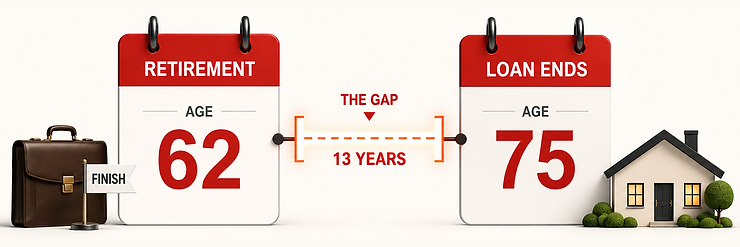
Take a couple I'll call Mark and Julie. He's 52, she's 50. Combined income of $220,000. A $620,000 loan with 23 years to run. They want to retire at 62.
On the current term, that loan runs until Mark is 75. Thirteen years of repayments after the salaries stop.
At 52, a rate rise is annoying. Their income absorbs it, they grumble, life goes on.
At 67, there is no salary. The repayments come out of super drawdowns and whatever else they've built. The income is finite and can't grow. Every rate rise comes straight out of their lifestyle, and they have no lever to pull.
That's not the same risk with a different date on it. It's a different risk entirely. And it's why "carry the loan and stay invested" feels fine at 45 and feels very different at 60.
Wanting certainty is a decision, not a deficiency
So when someone tells me they want the loan gone before they stop work, even though the projection says investing might leave them ahead, I don't hear financial illiteracy.
I hear a risk decision. A preference for a guaranteed outcome over a probable one, at the exact stage of life where the cost of the probable outcome failing is highest.
That's not something to be argued out of. In plenty of cases, it's the sounder call for the person actually making it.
Where I sit, and where your planner comes in
I'm a mortgage broker, not a financial planner. The question of whether your surplus money is better in super, investments, or the loan involves your tax position, your super balance, and your retirement income plan. That analysis belongs with a licensed financial adviser, and I work alongside planners on exactly these decisions. If you don't have one, I can point you to people I trust.
My side is the debt. Whether your loan structure actually rewards extra repayments. Whether your offset is doing its job. Whether your payoff date lands before or after your last day of work, and what it would take to move it.
The takeaway
After 30 years in this industry, my honest observation is this. I've never met anyone who regretted owning their home outright at retirement. I've met plenty who regretted carrying a mortgage into it.
If the plan you actually want is to be debt-free by the time you finish work, you don't need permission. You need a structure that gets you there.
Start with one number: the gap between your planned retirement date and your loan payoff date. If your loan term outruns your career, that gap is the problem worth solving.
If you want to see what closing it would take
I'm happy to run your numbers. No obligation, and I'll tell you honestly if the change isn't worth making.
**This article is general information only. It doesn't consider your objectives, financial situation or needs. Decisions about superannuation and investments should be made with a licensed financial adviser. Rates and figures are illustrative.


Comments